When GPUs Become Geopolitics
AI, Simulation, and European IT Sovereignty
Engineers who run simulations and train AI models tend to treat compute like water and electricity: always available today, surely available tomorrow. That assumption no longer holds. Over the past two years, a series of events has made one thing unmistakably clear — the foundation of your business is vulnerable to blackmail. Whether you accept that or change it is a strategic decision. This article makes the case for changing it, shows where Europe actually stands, and closes with three things you can do this quarter.
Four warning shots
A data center as a military target.
Earlier this year, for the first time, a large cloud data center was deliberately destroyed in the Middle East. Not by accident, and not because it sat next to a military compound — it was targeted precisely because, for many companies in the region, it was their single point of failure. The provider's response? AWS "strongly" recommended that customers migrate to other cloud regions and restore any inaccessible resources from remote backups. One hopes everyone had backups — physically separated from production.
The seabed as a front line.
Europe increasingly relies on data center capacity in the Nordics, and therefore on undersea cables. Those life-links are under active attack: eleven cables damaged in fifteen months. That is a pattern, not an accident. We talk a great deal about cloud providers and chip fabs, but sovereignty starts on the seabed. If a hostile actor can sever the cable, every layer of your stack above it runs at someone else's tolerance.
Even defense is rationed.
At the other end of the spectrum sit the models themselves. Anthropic recently released the most capable cybersecurity model to date — able to execute cyber-attacks and to defend against them with capabilities far beyond anything previous. Access is restricted to a short, exclusive list of organizations. If you can find a European company on that list, do let me know.
Data platforms as instruments of power.
And it is not only models. The CEO of Palantir — the company whose platform underlies the data of governments, defense ministries, and a growing number of European enterprises — describes his own mission as being there "to disrupt," to scare enemies and, on occasion, kill them. That is not a critic's caricature; it is the vendor's self-description. The question is not whether such a partner will turn on you tomorrow. The question is that they could — and someone else decides.
And then there are the GPUs.
The entire GPU production capacity for 2027 is already sold out. You no longer simply buy a GPU; you apply for one, and NVIDIA decides whether you get it. Jensen Huang put it plainly: "We do the best we can to allocate fairly, and to avoid allocating unnecessarily." Consider that vocabulary — allocate, fairly. That is the language of rationing, not of a market. In practice, every system integrator must report its customers' requests upstream and wait for a decision on which clients may receive GPUs. If you plan to buy in quantity, your CEO had better not speak badly about NVIDIA in public.
Your stack, layer by layer
Walk your own simulation and AI landscape from the bottom up:
Silicon — CPUs, GPUs, even RAM. In Europe, we practically have to beg for memory modules right now. Infrastructure — data centers, energy, networks, servers. Platforms — cloud, orchestration, data analytics. Models — the weights, and the ability to train them, on someone's hardware, somewhere.
On top of these layers sits everything a simulation-driven business cares about: digital twins, CAE and systems simulation, physics-aware AI, scientific ML, simulation data management. All of it rests on dependencies you do not control, and your accumulated engineering knowledge lives in data platforms you may not fully control either.
So ask directly: whose terms is your business running on? How many of these dependencies could be switched off — by an export control, a court order, an allocation email? And in each case, who decides? Today, it is not you.
What sovereignty means — and what it does not
The word is often misused, so let me be precise. Sovereignty is not protectionism. It is not autarky. It is emphatically not "buy only European." We do not need to build everything ourselves. Resilience rests on three principles:
Optionality.
Never let one vendor, one silicon family, or one jurisdiction be the only path to production.
Reversibility.
Architect so you can move. Switching cost is the real measure of dependence — if you cannot afford to leave, you have already been captured.
Redundancy.
Keep a working copy of what is truly critical, under your own laws and on your own hardware.
A GPU is no longer just a component. A frontier model is no longer just software. They have become a currency and an instrument of geopolitical power. The only question is whether we treat that as someone else's infrastructure problem — or as ours.
The European playbook: stronger than its reputation
There is, in fact, a European playbook, and for the first time in a long time it is more interesting than people give it credit for.
Start with public investment — there is real money on the table, more than ever before. In recent years, more than a dozen supercomputers have been built across the EU, operated under EuroHPC, essentially the compute arm of the European Commission. The fastest system today is JUPITER in Jülich, Europe's first exascale machine; next year it will be superseded by the even faster Alice Recoque. Crucially, these systems are open to industry, not just academia — you can apply for compute time. A new wave is being deployed right now in the form of AI Factories — nineteen in total, with systems like Mimer in Sweden and HammerHAI in Stuttgart already in production.
Europe's ambitions do not stop at buying machines. Starting this year, some of these supercomputers will be extended with CPUs from SiPearl — designed in Europe, built on European intellectual property. The first generation is honestly not yet performance-competitive, but the next generation will catch up. What matters is that the capability now exists.
Where the playbook is thin is the industrial half. Europe is genuinely world-class in academia and public research, but it lacks leading open-weight frontier models, sufficient industrial compute capacity (there is still no European hyperscaler), competitive CPUs and GPUs at volume, and data platforms on the level of a Palantir under European control. That gap is where the real work lies.
Sovereignty is a decision — the aerospace lesson
Why does Europe have a strong aerospace industry? Why do we build top-tier passenger aircraft, fighter jets, helicopters, and satellites? Because decades ago, when Europe stood at the brink of full dependence on foreign technology, the UK, France, Spain, and Germany took a strategic decision: they became shareholders of Airbus and committed to a long-term mission of building a sovereign aerospace industry. Being sovereign is not an accident. It is a decision.
In April this year, something similar happened in computing: the French state-owned investment fund acquired Bull — with science + computing as part of it — to accelerate the European playbook for a sovereign AI landscape. Bull is not starting from zero: it has delivered the majority of Europe's supercomputers and AI Factories, with custom servers manufactured in its own European factories, backed by its own patents and IP. And nobody buys these systems for the EU label — they buy them because the systems are often simply better, holding the top three positions on the list of the world's most energy-efficient supercomputers.
Backed by a ten-year investment agreement, the mission is explicit: build a world-class European ecosystem in AI, HPC, and quantum; ensure these strategic technologies remain in Europe; accelerate innovation for industry, research, and defence.
For an industrial user, that translates into something concrete: a credible non-US, non-Asian compute alternative with no compromise on performance; an open-source-based AI and simulation stack designed to dissolve vendor lock-in rather than create a new one; solutions that respect EU regulations by design, including mission-critical use cases; and a partner that cannot be externally influenced or controlled, with your IP and data protected against outside interference. There is also a boring-sounding advantage that stops being boring the moment an interconnect fails at 2 a.m.: the engineer on the phone speaks your language, sits on your continent, is governed by your laws, and can be in your data center by the end of the week.
Proof point: re-architecting a global manufacturer's CAE landscape
A recent example makes this tangible. A few weeks ago, we completed the re-architecture of the entire CAE simulation landscape of a leading European manufacturer. Three compute sites were created — two in Europe and one in Asia. The customer provided the concrete slab; essentially everything else arrived pre-assembled in modular data center containers, built in our own factory and lifted from the lorry onto the slab like Lego blocks. From concrete slab to production in a matter of weeks.
On the middleware level, the three sites are federated into one virtual, redundant cluster — redundancy at a global level — fully integrated into the existing tooling and workflow automation, with a large low-latency storage layer underneath. The design principles: simulation engineer first, minimum total cost of ownership, exascale-grade performance and efficiency. The long-term partnership also includes co-creating what comes next — confidential computing, physics-aware AI, next-generation simulation data management — which is where the public details must end, because we are now talking about digital product-creation capabilities beyond what our customer's competitors can do.
The honest ledger: sovereignty is not free
It would be dishonest to present this as a clean win. The costs are real. CUDA still has the most mature kernel ecosystem on Earth; ROCm is closing the gap, but it is not closed. Bleeding-edge training throughput is genuinely higher on the US hyperscalers. Multi-vendor simulation architectures cost engineering hours. Open weights demand operational investment that a managed API does not.
Name those costs — and then weigh them against the other side of the ledger, which stays hidden until it doesn't. You do not see what an export control costs until your vendor cannot ship. You do not see what jurisdictional exposure costs until a foreign discovery order arrives. You do not see what a concentrated supply chain costs until a single fab goes offline.
A small, known engineering premium today, against a large, unknown operational loss tomorrow. That is insurance, not idealism.
Three things to do this quarter
Not next year. This quarter.
1. Review the stack.
For every workload, answer: where is it running, on whose silicon, under whose terms — and what would it cost to move it? Be honest, because "we cannot move it" has a precise meaning: it owns you.
2. Stand up one workload on European infrastructure.
EuroHPC compute time, European hardware, an open-weight model, a sovereign stack. One real workload — established as a permanent capability, not a pilot.
3. Unify the roadmap.
Stop procuring simulation and AI infrastructure separately. The convergence is happening whether you plan for it or not, so align the two roadmaps now.
The rules of this technology are being written as we speak — in code, in contracts, in standards. Be at the table, not on the menu.
Sovereignty is a strategic choice, not a technical one.
This article is based on a talk given in July 2026. Dr. Marcus Camen is CTO of Bull science + computing.
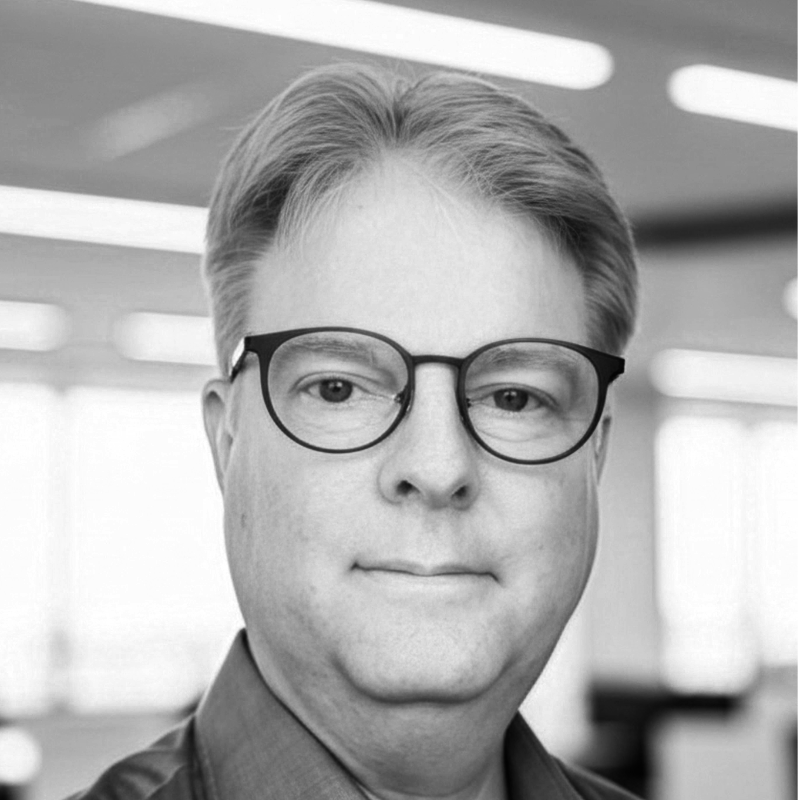
Autor: Dr. Marcus Camen
Dr. Marcus Camen is CTO of the science + computing business unit at Bull, where he works closely with customers to shape simulation and AI environments that are ready for the future. He is passionate about pushing the boundaries of simulation and accelerating Europe's innovation sovereignty.
Before taking on this role, he spent many years at science + computing hands-on designing HPC-based IT environments that enable engineering teams to get designs "first time right" through digital simulation.