
Humanoid Safety: Where Simulation Must Meet the Real World
Insights from the Humanoid Safety Summit 2026
Humanoid robots are moving toward industrial use, but an impressive demonstration is not yet a safety case. At the Humanoid Safety Summit at Arena 2036 in Stuttgart, robot manufacturers, industrial users, researchers and standards experts examined what it will take to deploy dynamically stable robots around people. The summit was held on November 13 alongside a meeting of ISO/TC 299 Working Group 12, which is developing a safety standard for dynamically stable industrial mobile robots.
For the ASCS simulation community, the central question is compelling:
What can simulation establish about a humanoid robot’s safety - and what must still be demonstrated in the physical world?
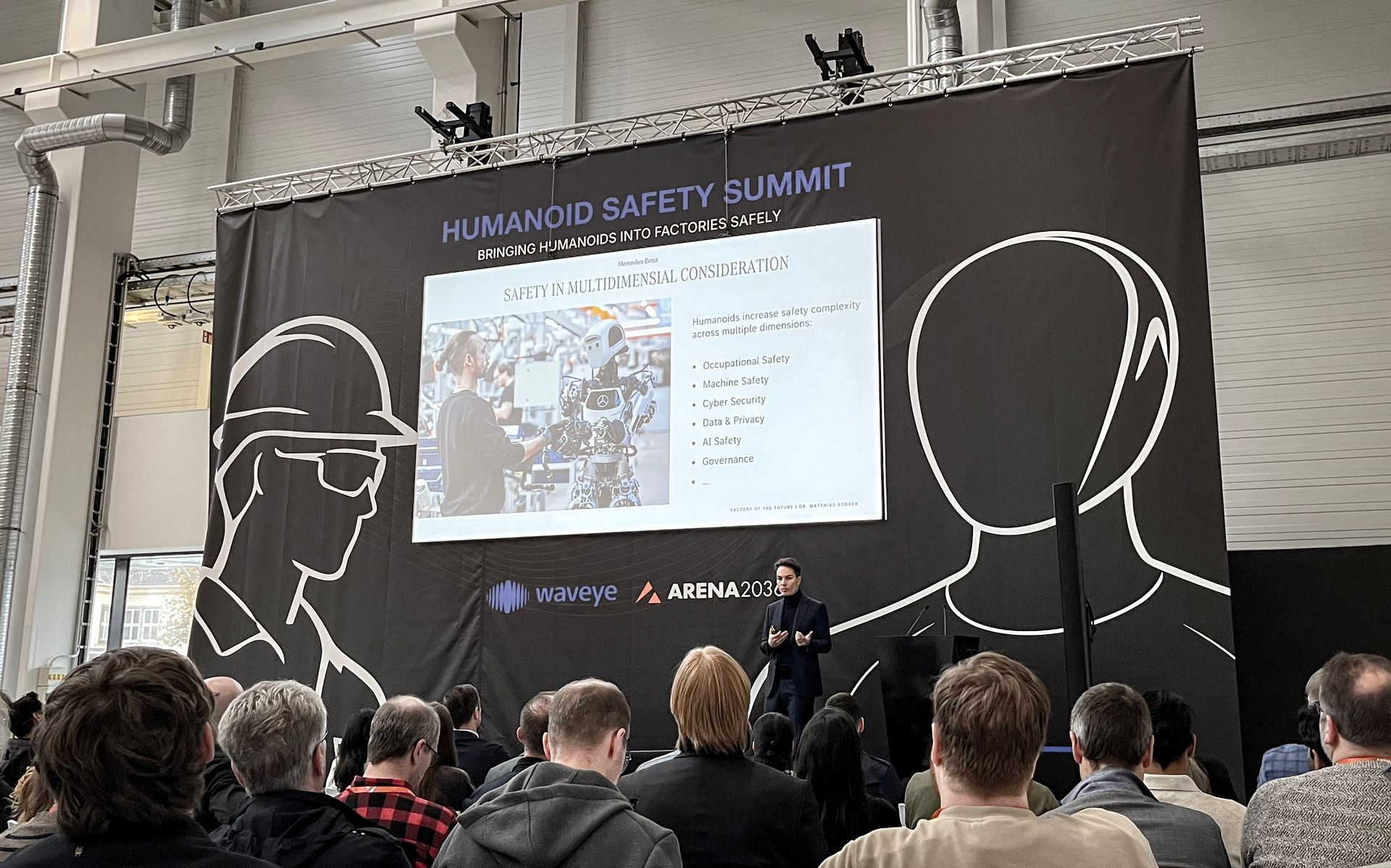
Safety is a system property
Dr. Matthias Forger of Mercedes-Benz argued that safety must be designed into the architecture from the beginning, rather than added after a robot can perform a task. Mercedes-Benz uses digital twins to plan and simulate production systems and to test safety requirements before implementation. Its longer-term concern is not just whether one robot completes a task, but how fleets of robots can be monitored and operated safely in a production environment.
That changes the scope of a useful simulation. A model of robot motion alone cannot answer questions about people entering a shared workspace, a disrupted pick, a communication loss or the interaction between a robot and its surroundings. The relevant unit of analysis is the robot in its operating environment, including its sensors, controls, tasks and human interactions.
The difficult cases are the ones we need to test
Dr. Federico Vicentini of Boston Dynamics described the gap between capable robots and unpredictable environments. Objects, human behaviour and physical manipulation can introduce disturbances that are difficult to anticipate in advance. He proposed scenario-based validation, with clearer criteria for which situations to test, how often to repeat tests and how to account for residual uncertainty.
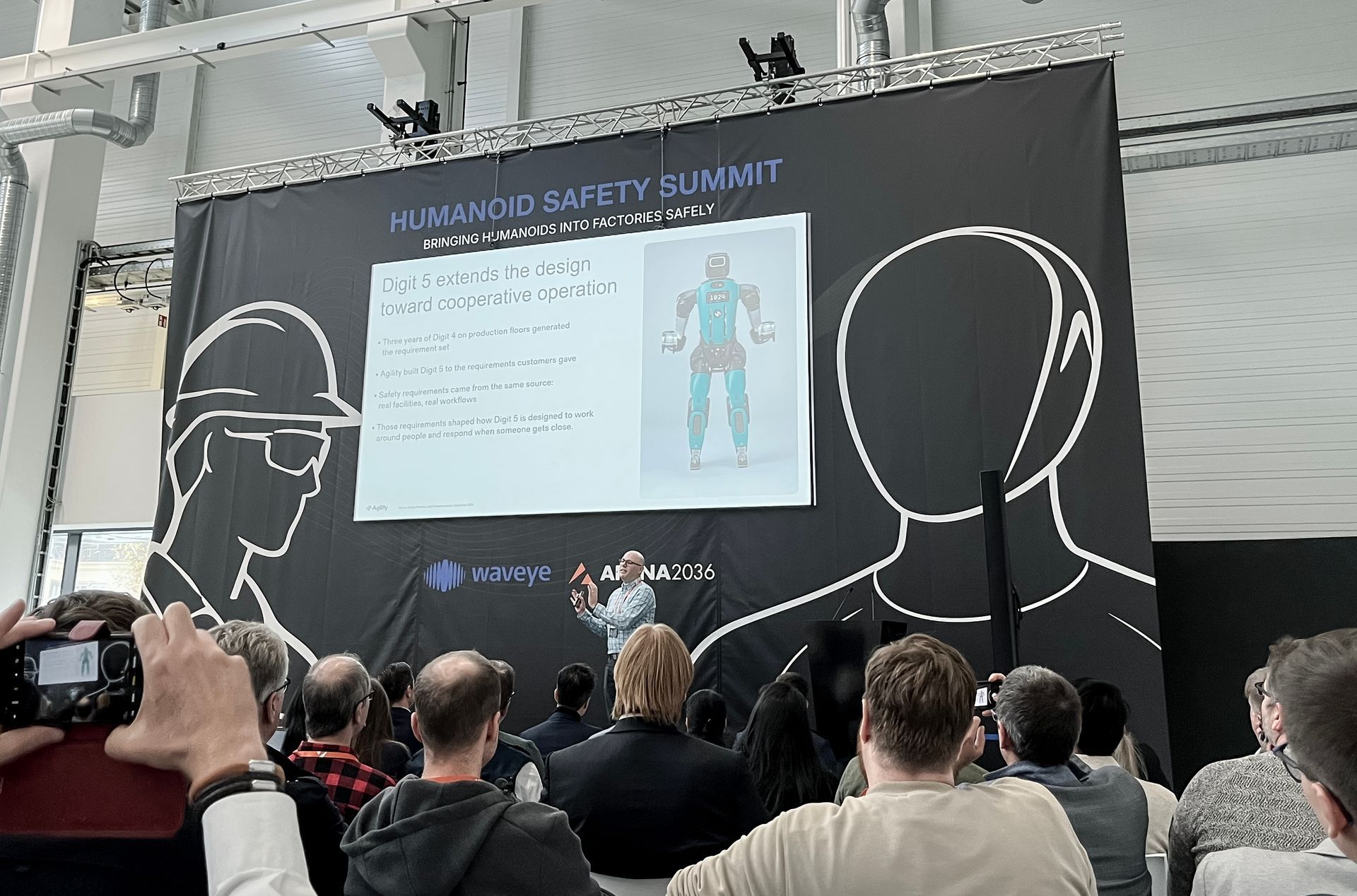
Kevin Reese of Agility Robotics described safety as a progression informed by deployment experience. For Digit V5, separation is the primary safeguard: the robot should avoid a person where possible, slow or stop as someone approaches, and sit down if necessary. He also explained why demonstrating stability or safe contact to a defined safety performance level remains especially difficult for a balancing, moving robot.
These examples suggest a productive role for simulation: systematically vary conditions that are hard, costly or unsafe to reproduce repeatedly on a factory floor. But generating many scenarios is not, by itself, proof that the scenarios represent the risks that matter.
An agenda for the simulation community
Several questions from the summit deserve focused work across simulation, robotics and safety engineering:
- Which scenarios belong in a safety assessment? We need methods for identifying relevant combinations of tasks, people, obstacles, payloads, disturbances and foreseeable failures - not merely generating more test cases.
- How do we establish simulation fidelity? Riccardo Mariani of NVIDIA emphasised comparing simulated situations with real-world data and assessing accuracy, including end-to-end behaviour. A simulation result is only as persuasive as the evidence that its model is valid for the claim being made.
- How do we quantify uncertainty and coverage? Speakers identified open questions around residual risk, sufficient repetitions and the treatment of AI behaviour outside expected conditions. The community needs ways to communicate what has been tested - and what remains unknown.
- How do we connect virtual and physical testing? Benedikt Pulver of TÜV SÜD described simulation as valuable for investigating edge cases, while cautioning that virtual testing alone cannot establish safety. The challenge is to build a traceable chain from simulated scenarios to physical tests and an application-specific safety argument.
- How do we keep evidence current as systems change? Humanoid capabilities and AI models will evolve. Safety assessment needs to account for changes to software, tasks, sensors and operating environments - not just an initial configuration.
From useful models to credible evidence
The summit made clear that simulation has a vital role in accelerating learning. It can expose weaknesses before deployment, support repeatable tests and help explore rare combinations of events. At the moment does not remove the need for real-world validation or a clear account of a model’s limits.
That is an opportunity for the ASCS community: to bring simulation expertise into closer conversation with robot developers, industrial users and safety specialists. The goal is not simply more realistic digital twins. It is simulation evidence that others can understand, challenge and use when deciding whether a robot is ready for a particular environment.